

How HA changes with age, why molecular weight matters, and how a multi-molecular formulation addresses the skin’s hydration decline
The human skin contains approximately 15 grams of hyaluronic acid, distributed unevenly between the dermis and epidermis. Of this amount, nearly half resides in the dermis and the extracellular matrix that supports the collagen and elastin network. It is a silent, invisible presence that works constantly: it regulates the water content of tissues, modulates cell migration, and participates in tissue repair.
With age, this presence diminishes. Not gradually and uniformly, but according to distinct mechanisms that depend on how the skin ages: from within, as the years go by, or under the cumulative effect of the sun.
The role of hyaluronic acid in the skin: more complex than it seems
HA is a linear-chain glycosaminoglycan composed of repeating disaccharide units of D-glucuronic acid and N-acetyl-D-glucosamine. Its extraordinary hygroscopic capacity, capable of retaining up to 1,000 times its weight in water, is only one of its biological functions. Dermatological literature describes it as an active modulator of cutaneous inflammation, an organizer of the extracellular matrix, and a signaling molecule involved in keratinocyte proliferation and migration.
What makes HA particularly relevant from a formulation standpoint is its dimensional heterogeneity. There is no single “hyaluronic acid”: in nature, chains of highly variable molecular weight are found, ranging from a few hundred kilodaltons to several million. And molecular weight is not a secondary technical detail: it determines where the molecule acts, how it interacts with cell receptors, and which biological responses it activates.
Intrinsic and extrinsic aging: two profiles of HA loss
The research by Papakonstantinou, Roth and Karakiulakis precisely describes this dual dynamic. In intrinsic aging, the chronological kind linked to the passage of years, the decline of cutaneous HA is driven by a downregulation of the synthases HAS-1 and HAS-2: synthesis slows, while degradation proceeds at a normal rate. The result is progressively less hydrated skin, with an impoverished extracellular matrix and a reduction in dermal turgor.
Extrinsic aging, dominated by chronic sun exposure, follows a different and in some respects more aggressive path. Ultraviolet rays induce an overexpression of hyaluronidase enzymes, in particular HYAL-1, HYAL-2 and HYAL-3. These enzymes fragment high molecular weight chains into smaller oligosaccharides, with significant biological consequences: low molecular weight fragments exhibit pro-inflammatory properties, while intact high molecular weight chains fulfill an anti-inflammatory and regulatory function.
The claim that 80% of visible facial aging is attributable to sun exposure is not a casual observation: it is the estimate that emerges from the photodamage literature, and explains why the formulation response cannot be uniform.
Why the molecular weight of HA is decisive in cosmetic formulation
This biological distinction between high and low molecular weight HA has direct implications for formulation. High molecular weight molecules form a hydrating film on the surface, limit transepidermal water loss, and act as support matrices for the skin barrier. Low molecular weight molecules, on the other hand, penetrate more deeply into the epidermal and dermal layers, where they can reach CD44 and RHAMM receptors and stimulate cellular responses related to tissue regeneration.
A formulation that uses a single molecular weight addresses only one level of action. A multi-molecular approach, combining HA fractions of different molecular weights, makes it possible to act simultaneously on multiple skin levels: surface, intermediate epidermis, dermal-epidermal junction. It is the difference between surface hydration and a biologically layered action.
HA Serum and HA Regenerating Cream: two distinct formulation responses
It is within this scientific context that the formulation rationale of the Armonita Laboratoires collection is situated.
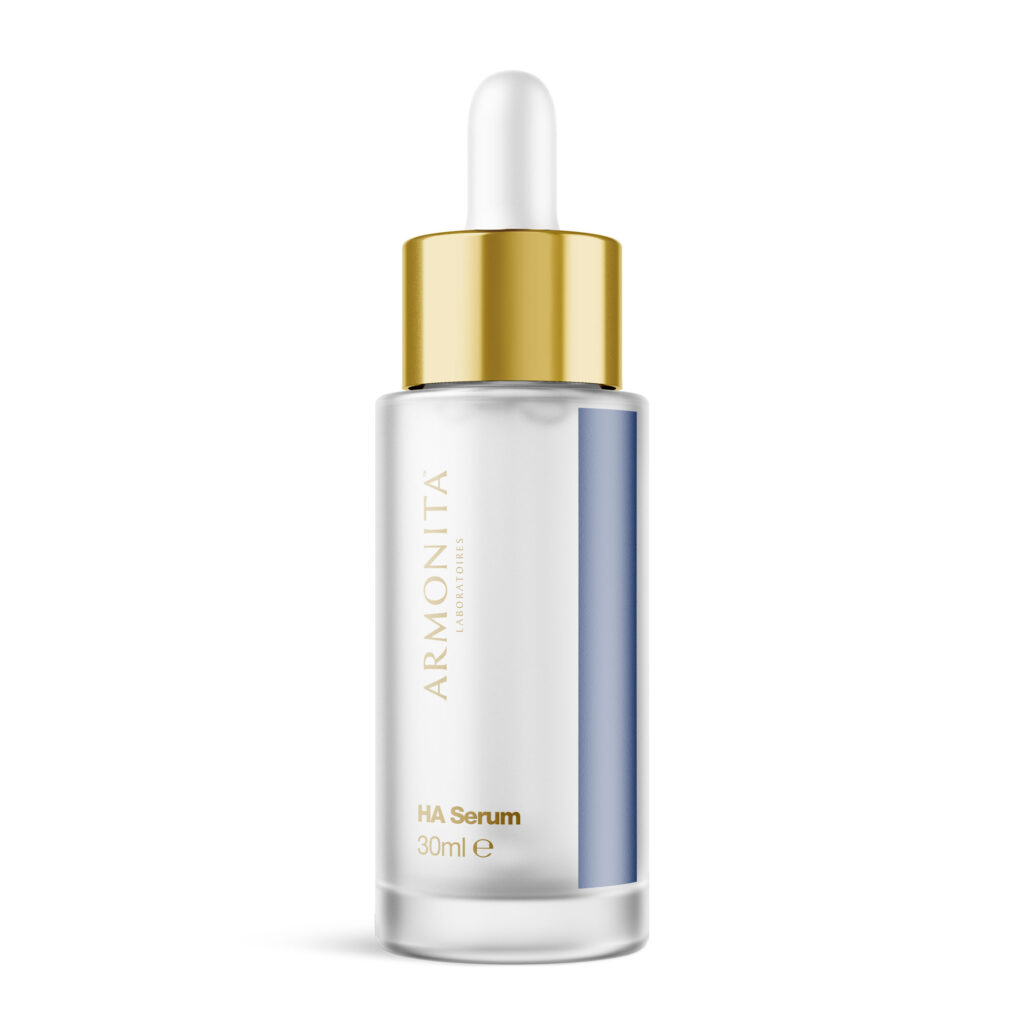
Armonita HA Serum
The HA Serum combines multi-molecular HA with Hyacare 50, a high-bioavailability low molecular weight HA fraction, and Xilogel HS, a natural-origin film-forming agent that amplifies the surface hydrating capacity. The presence of D-Panthenol and Niacinamide adds a soothing and regenerating profile, while Glycotensyl contributes to optimizing the distribution of the serum over the skin layer.
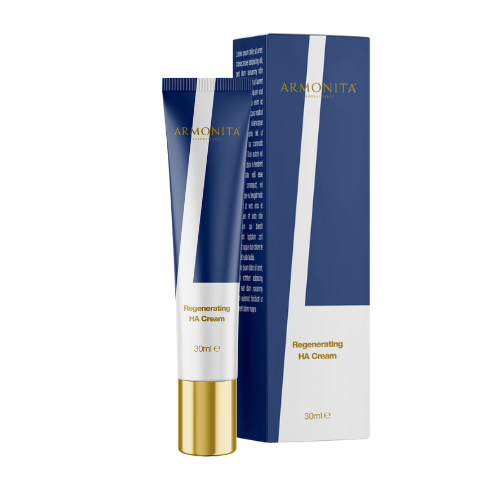
Armonita HA Regenerating Cream
The HA Regenerating Cream addresses a different need: not just deep hydration, but the reconstitution of the lipid barrier. The combination of shea butter, cocoa butter, and argan oil provides a rich lipid matrix, while Ceramide 3 and Corneopeptyl support the structure of the stratum corneum. Exo-H acts as a booster of endogenous HA biological activity; Bromelain offers a gentle exfoliating action that primes the skin to receive active ingredients. IBR-Urbiotect and Skinectura complete the profile with protective and biomimetic action.
The post-treatment window: when topical HA has maximum impact
Research on HA has documented a fact often underestimated in aesthetic practice: during skin repair processes, local synthesis of hyaluronic acid increases significantly as a physiological response to tissue damage. This mechanism, observed in wound healing literature, suggests that the period immediately following aesthetic procedures, laser treatments, or chemical peels represents a biologically active window, in which topical support with multi-molecular HA can accompany and enhance the endogenous regenerative response.
The formulation profile of the HA Regenerating Cream is designed precisely for this context. The combination of HA, ceramides, plant butters, and biomimetic actives builds a support network that acts on the compromised barrier, reduces the local inflammatory response, and promotes optimal recovery of skin hydration in the hours and days following treatment.
Are you a distributor interested in the Armonita collections?
Source: Papakonstantinou E., Roth M., Karakiulakis G., “Hyaluronic acid: A key molecule in skin aging”, Dermato-Endocrinology, 2012; 4(3):253-258. DOI: 10.4161/derm.21923

